

Artificial Intelligence has gained popularity these days. AI can be found in many products that we use today. News recommendations, product recommendations on online stores, voice assistants like Google Assistant, chatbots (like ChatGPT), etc. AI has influenced many industries like healthcare, banking, manufacturing, cyber security, music and arts and so on. With the term Artificial Intelligence, there are some popular terms associated with, namely Machine Learning (ML), Deep Learning (DL), Generative AI (GenAI), etc. While these buzzwords have been used interchangeably, it has created a confusion and misunderstandings. Do these terms refers to the same thing? or they have separate unique characteristics and meanings? This blog post will demystify these buzzwords in simple terms for you.
Actually AI, ML, DL and GenAI are closely related to each other, but have different roles. To understand this, take a look at below diagram. This diagram describe the difference as well as the relationship with those terms. Machine Learning is a subset of Artificial Intelligence. Deep Learning is a subset of Machine Learning, while Generative AI is a subset of Deep Learning. However, ML, DL and GenAI all falls under AI. Let’s try to understand this with their functionality.
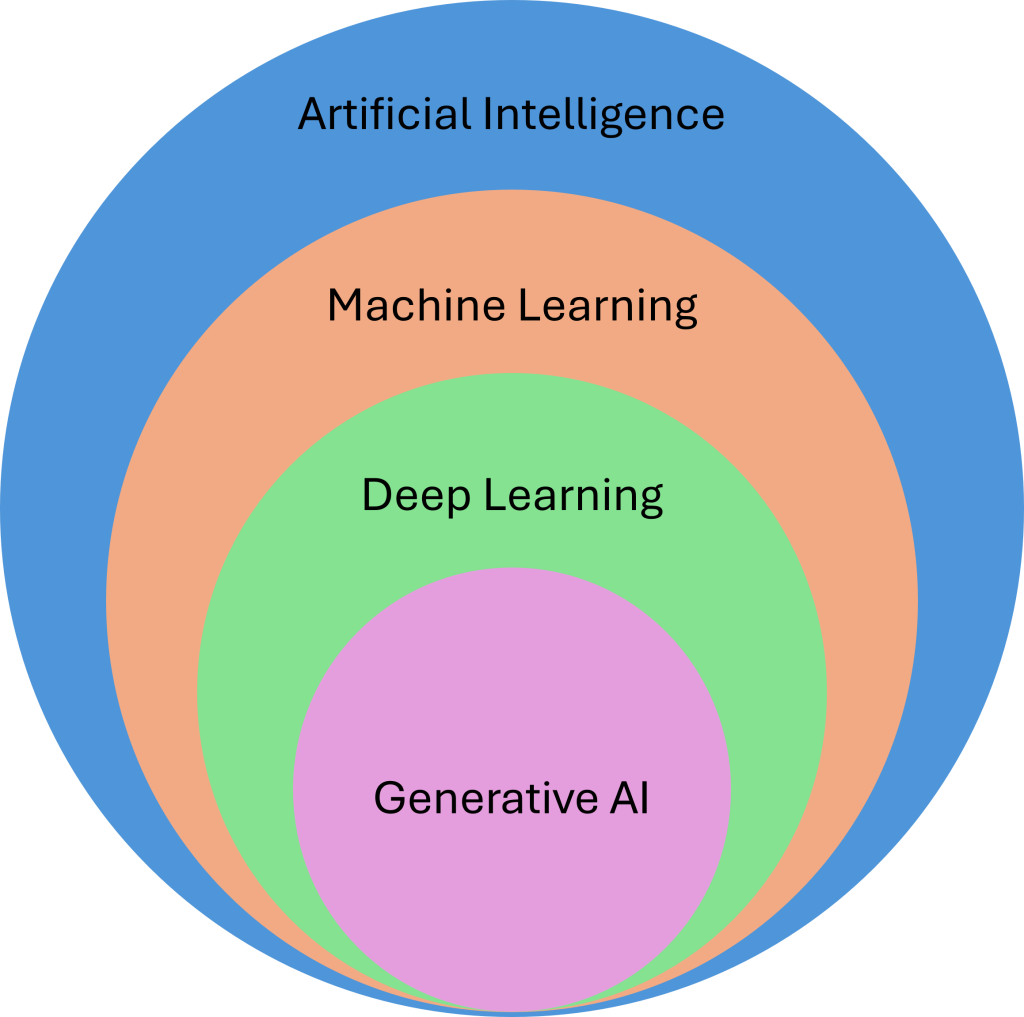
What is Artificial Intelligence (AI)?
We all know computers work according to a set of commands given by humans. Computers can’t work without humans, or can they? Artificial Intelligence (AI) has many definitions. However, AI is used as a broad range of techniques that are used to perform tasks that need human-level intelligence. AI can be considered as a broader discipline that aims to enable machines to learn, think and make decisions by rule-based methods, statistical methods and/or algorithms.
Simply AI means, ability of computers or machines to think and make their own decisions without human intervention. It is basically mimicking human behavior. Usually this idea looks scary because it has been socialized as the end of human civilization by many Sci-fi movies. But it’s not. And… yeah it can be. But we haven’t reach that level yet. So don’t worry.
Read more about Artificial Intelligence here.
What is Machine Learning (ML)?
Machine Learning (ML) is a set of techniques and algorithms which uses to train computers or machines from data to perform a particular task without being explicitly programmed. ML basically uses statistical methods to find patterns in data and make predictions or decisions based on those patterns.
However, scaling an ML model on larger dataset is not an easy task. Before training an ML model, ML Engineers need to figure out relevant features from the dataset, that are useful for training the model. This often need deep understanding in the particular domain of the dataset and thorough statistical analysis. Due to this challenge in ML, a novel method was introduced that uses the concept of Neural Networks which are inspired by human brain. This method is known as Deep Learning (DL).
Read more about Machine Learning here.
What is Deep Learning (DL)?
Deep Learning is a subset of machine learning which is inspired by how human brain works. Deep Learning is consist of multiple layers of Neural Networks. Neural Networks are the integral part of Deep Learning. In most occasions Deep Learning and Machine Learning terms are used interchangeably, but they have unique characteristics.
In DL, Neural Networks helps to filter the data we feed and extracts relevant features. This helps to skip manual feature engineering, which is convenient to work with larger datasets. As this technique is inspired by how biological neurons work (not exactly as that) it is known as Neural Networks. We can think this as the neurons of computers.
However, due to the complexity of Neural Networks, it is harder to interpret a DL model. This makes it difficult to understand how the model actually works. DL models are often refers to as black boxes due to this.
Read more about Deep Learning here.
What is Generative AI (GenAI)?
Generative AI (GenAI) is often refers as AI these days is actually a sub branch of Artificial Intelligence. It is also a subset of Deep Learning which uses deep learning techniques for training models. Traditional DL models are designed to analyze, predict and/or classify input data. Generative AI models are designed to generate new unique content based on the instructions or prompts we input. GenAI models are capable of generating texts (including code), images, videos and audios (including music). GenAI is a huge breakthrough in AI. OpenAI’s ChatGPT, DALL-E, Google Gemini, Imagen, GitHub Copilot, Midjourney, etc. are some popular examples for GenAI.
GenAI is designed to generate new content learning from the datasets it was trained on. Due to this creative ability, GenAI is often refer and considered as AI. But AI is much broader term which is not limited to GenAI.
Read more about Generative AI here.
Conclusion
Well this is a very brief introduction to Artificial Intelligence, Machine Learning, Deep Learning and Generative AI. There are lot more things to learn about them. I will discuss each of these technologies separately and then we’ll learn how to use them. So stay tuned.


